Tuesday, November 30, 2010

Prague Day 5: Vyšehrad and Petřín tower

Before I start on my last day in Prague, I wanted to mention a synagogue in the Jewish Quarter which is now empty, its walls painted with the names of the Jews who used to live there but were killed in the Holocaust. The entire building was an endless list of names, from roof to floor. I found my mother's birth name, Klein, and while it's a common enough name that there was likely no relation -- I certainly don't know of any Czech connection in our family tree -- nevertheless, it made me think of how many of my family members were murdered like these. My mother used to show my old black-and-white pictures of large extended families, all of whom had been killed. Her parents had both been survivors of Auschwitz; all there relatives had not made it. It's a hard thing to imagine. Even my father's mother was brought to Israel from Poland by her father to check the place out before bringing the rest of the family along. The father left her in Israel while he went to Poland for the rest. That was the last she saw of him or any of them. I always feel chills when I think of that.

On my last day in Prague, I walked south to the Vyšehrad castle, which included a cemetery for famous figures, whose graves were really fancy.
Along the way I saw the Tančící dům (Dancing house), by Gehry. I always loved this building in pictures, and was surprised to see that it was in the old city, right there among the baroque pastel buildings. It also looks better in pictures; somehow the choice of materials -- more visible in the flesh -- wasn't what I would have chosen. And the curvaceous glass section -- the "Ginger" of the Fred-and-Ginger -- was a dummy glass curtain, with the actual glass room windows behind it, separate. No one inside can walk up to that glass.

I then went up the hill overlooking the city, and climbed Petřín tower (all stairs) for an amazing view of the city. Though the tower itself is a tiny fraction of the size of the Eiffel Tower, because it is on a very high hill, the height above the city is comparable to that of Paris' (truly gargantuan) structure. (The mirror maze, by the way, was an utter waste of money.)

Being ill, I wasn't very social on this trip. I did get a bare initial taste on what living in the Czech Republic was all about, enough to make me think I'd need to stay longer, at least three weeks, to get beyond the tourist facade to see a sense of the culture. Mostly the people here seemed thin and unfriendly. They were all white. But my insight was limited. It's a little strange to think that everyone under 21 never experienced communism at all. I remember visiting the Soviet Union, where stores were more like warehouses, bare and unwelcoming places without adornment for picking up cans of this, or some tough loaves of bread, or some weak-looking fruit, with no efforts at quality or effort to sell the store or the products. At the base of Petřín Hill was a monument to the victims of Communism, and though I'm sure he didn't mean culinary victims, you can see me comforting two of the statues that repeat as you go up the stairs, each statue more and more in pieces as you go higher up the increasingly inclined steps.

That's not a happy note on which to end my trip, so let me instead show the John Lennon wall, as a tribute to his anniversary. This wall kept getting spray painted with John Lennon stuff all through communist days and still today. And with that, goodbye Mr. Medieval Prague!
 

Monday, November 29, 2010

Prague Day 4: Kutna Hora

Before coming here, I couldn't have named any famous Czechs besides composer Antonín Dvořák. Now I can name Franz Kafka (Jewish vegetarian!), Alphonse Mucha, and Good King Wenceslaus (technically a prince).

(I also noticed that Karel Čapek's R.U.R. -- Rossum's Universal Robots -- famous for introducing the word"robot", must be the source of the name of the evil corporation in Dollhouse!)

Sleeping through a fever, my nostrils stuffed with tissues, was hardly fun. Still, I got up early to catch an 8 am bus to the town of Kutna Hora, about an hour outside of Prague. The ground was covered with snow, and the snow would continue falling all day at a heavy pace. Looking out the bus windows, there was no horizon, as white fields blurred seemlessly into grey skies. At the bus stop, trying to figure out where to go with no English speakers wasn't easy, but I did end up on a bus to Sedlec, a suburb and home to the Ossuary.

An abbot returned from a visit to Palestine and sprinkled here some dirt from the site of Jesus' crucifixion, making it a popular burial place. Some 50,000 people were buried here during the Black Death and Hussite Wars. With so many human bones, why not use them for kitchy art? And so this church was made to look like a Goonies set, except that these are the real thing.
 
Me, boning up on medieval
heraldry. I can't wait tibia
expert. Isn't it humerus? Ha!

I then trudged through some eight inches of snow on my way to town, before finally stopping a passer by, pointing ahead, and asking, "Kutna Hora?" She pointed the way I'd come. Dammit. So I turned around and trudged back. Times like these would be more fun with company, unless they're the type to whine.

But really, this is no weather in which to visit Prague. Or anywhere, really.

So, I finally made it into town. This had been a silver-mining town, back when the mine was a huge source of wealth for the country. Mining towns make me think of poor, blue-collar, coal-dust-covered collections of homes, but this was no less fancy than Prague (and no less pastel), if smaller in scale.

Indeed, while it's probably prettiest in spring, the snow at least made the trees absolutely beautiful and white, while making the outdoor statues mysterious. The cathedral of St. Barbara looked glorious, especially as seen from a distance, rising above the trees of the park behind the Spanish Court, a medieval-looking building that had once housed royalty.
 
Some things look prettier in the snow.

A romantic moment at the
Spanish Court with a frisky royal.

Taking the small ways off the main streets, fancy baroque buildings quickly turned to old stone houses. People lived in these houses, which was pretty cool, since they look right out of medieval village life.

All the places in Prague I've been to are really a big tourist ghetto. No one lives there, it's just too expensive. Everyone in the city is a tourist. (The Christmas market is a noteable exception.) In Kutna Hora, for the first time I felt like I started to get a feel for Czech life. I saw stores they shop in. I saw kids throwing snowballs at each other. A young woman slipped and fell in the snow while talking on her cell phone, and laughed about it. You know, normal life. If I had more time, I'd spend it out in the land of the locals, where I can get a feel for the life and culture of this part of the world. But, alas, I have only one more day.

Sunday, November 28, 2010

Prague Day 3: The Jewish Quarter

By the way, what's this thing with painting houses in pastels? I hated that in St. Petersburg, and while I don't hate it here, I still think it's a stupid idea. In Prague vs. Paris, on this alone Paris wins.

I slept in today to help with the sleep issues. Then, after limping my way (step....... step........ step......) to find a pharmacy, thank you ibuprofin, I became walkative. So today I tackled the Jewish Quarter, formerly a walled ghetto. Most of the homes had since been razed and rebuilt, but there were some beautiful synagogues -- I thought beautiful houses of worship were a Christian thing.

The museum exhibits served mostly to show they used the same ritual objects then as we do today. But it did teach me more about the history of the Jewish community here. As you'd expect, it was not a happy story. Jews were forced to live in the ghetto. They had to wear a special badge identifying them as Jews. They were not allowed to do any jobs except as money lenders (which for Christians was a sin). At one point, only the oldest son was allowed to get married. Really sucked for them. It wasn't always this way, there were tolerant times too when the rules were taken down and Jews were free (usually in return for high taxes). Of course, all the Jews are gone now, having been shipped to the Terezin concentration camp by the Nazis from which few survived.

Among the Jewish landmarks is the oldest synagogue in Europe (in whose attic the remains of the golem are supposedly kept), as well as the Jewish cemetery (where the rabbi who created the golem is buried). With limited space, the community kept covering the plot with dirt and burying more people over the older graves, layer upon layer, each time bringing up the gravestones so that now it is littered with hundreds of years of gravestones.

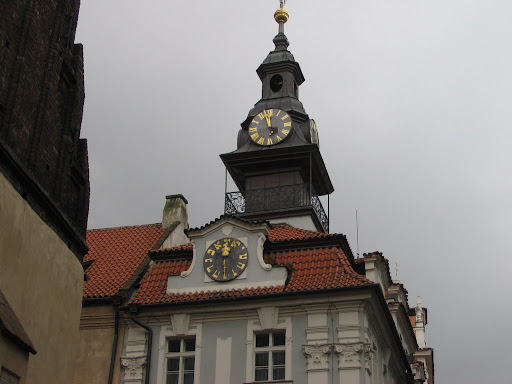
Also, an interesting clock tower whose Hebrew clock circles counterclockwise.

I finished the day with a ghost tour. Among other things, we went into the underground beneath the old town hall, and saw the dungeon and torture rooms. Apparently the executioner in those times had a very special jobs. Of course, he killed people, and tortured people, and dug up the bodies of suspected vampires to hack the corpse up, but he was also utterly cut off from society, unable to talk to anyone who wasn't an executioner. Even touching a regular person would make them cursed. The child of an executioner had no choice but to become one himself. Seriously, I'm glad we've made progress since then -- but in a country which still throws people into dungeons and tortures, maybe I shouldn't be all that glad. Indeed, bringing back the executioner caste might help address that vampire epidemic.

I just want to add one bit about history which amazed me when I learned it, and that's my favorite despot: Holy Roman Emperor Joseph II. His mother, Maria Theresa, was a Catholic zealot whose enforcing of orthodoxy on Protestant lands (like Bohemia, now Czech Republic) led to the 30 years war, which the Protestants lost. The 28 leaders of the rebellion were kept and tortured in the aforementioned Town Hall dungeon, before being executed in the Old Town Square. The Jews, by the way, sided with the Catholics, and were rewarded for it. Ok, now that I've tied this in with today's events, let me get to Joseph II.

Although he was a dictator, he was the most liberal dictator I've ever heard of. He emancipated the peasants, established freedom of religion, abolished serfdom, and abolished the death penalty and brutal punishments, imposed equality of treatment for offenders, ended press censorship, established compulsory education for all boys and girls, lots of cool stuff. As a result, he was widely hated, there were revolts, and he died after just ten years (bitter about his utter failure), whereupon most of his reforms were undone. Go liberals!

Going to sleep, it was clear that this wasn't just a cold, but a fever. All night I suffered, tissues piled next to me, trying to stay warm...

Saturday, November 27, 2010

Prague Day 2: Christmas Tree

The next day, a thin powder of snow sat over everything. At below-freezing temperatures, it never melted. I used the day to see everything on the left bank again by daylight as part of a tour. Still beautiful, but it really is best seen with the lights down -- make that your first glimpse too, if you come visit. Here's a daytime view of the palace, but it doesn't look like much here. Just trust me, it's awesome, as in "awe".


Walking back to the Old Town Square, I popped into the library (like almost every building here, a beautiful building in its own right). They had this cool circular column of books from floor to ceiling, with a flame-shaped space in one side (left). When you look through the hole into the column, you see that the column goes a heck of a long way down and up.
 
Now, I know it must be done with mirrors, but it's still brilliant.

At night, when I returned to the Old Town Square near which I was staying, it was packed tight with people. Apparently they were about to light the Christmas tree. I'd never seen the one in Rockefeller Center, so I stuck around for this one. It was beautiful. Damn, why is their huge tree better than ours? Our colored lights look stupid. (Sorry, my videos of everything won't load.)


In addition to throngs of Czechs, there were stands selling stuff in a kind of Christmas Market. I tried a syrup wafer, which was really yummy (see left), and a trdelnik, strips of dough wrapped around a cylinder (called a "trdlo") which rotates over a fire under the dough is browned, and then the pastry slides off the cylinder and is covered in cinnamon and sugar -- very much like a cinnamon-sugar pretzel, but soft like an Auntie Anne's inside and crunchy on the outside (see right), and also some potato pancakes with sauerkraut, and some roasted chestnuts.
 

All the while, performers were playing what I'm guessing is traditional Czech music while dressed in traditional Czech garb. Everything was full of the Christmas spirit, which is really a great feeling. Something cool that Christians have done. Even if, according to the last census, 59% of Czechs call themselves agnostic, atheist, or non-believer, and according to another poll, only 19% believe there is a God. Ironic, considering that the city is littered with medieval Christian churches and statues, and was the start of the 30-years war between Protestants and Catholics (I saw the window through which the defenestration that started it all happened).

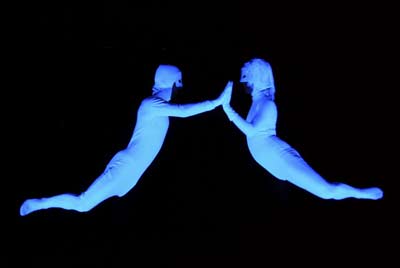
I then went to a blacklight show at Pařižska 4. Pretty cool effects, the way they dance with only the painted parts visible, making it seem like things are floating about magically and doing moves that appear humanly impossible. The key struggle was keeping my eyes open. Perhaps I haven't defeated jet lag yet.

There is a downside. At the end of the day, my leg was in pain, something that used to happen a decade ago but hasn't been an issue since. I tried to use mostly my other leg. But then, my back started hurting, so that it was difficult to walk. On top of that, I have a cold, so I'm constantly dealing with a runny nose and sore throat. So everything bad is coming together for my vacation. Yay. Hopefully some sleep will help.

Friday, November 26, 2010

Prague Day 1

Dobrý den from Prague.

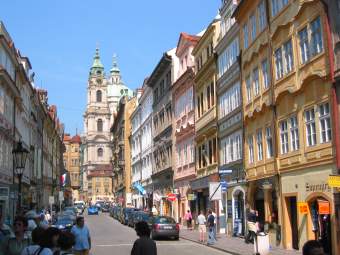
Prague is a cute town. The cobblestone streets are lined with old pastel buildings, so that you can feel the oldness of the place. Walking around the Old Town and the New Town (from the 14th century, "new" is a relative term), I was mostly unimpressed. It's cute. The Old Town square is quite nice though, especially that one church with the cool roof.


Being winter, night fell rather quickly, and as I wandered the streets, I came upon the Charles Bridge at dusk, and WOW. This is what people come to Prague for. The view from the bridge, lined with huge ominously dark statues, of the Prague castle on the hill past the Vltava river, was simply spectacular. It's not even worth posting a photo, it won't do the sight justice. That castle is freaking huge. And stunning. Especially when lit in the gloam.

Not just the bridge and the castle. The other side of the river, the "Lesser Town", was so much more impressive. Fancy buildings, winding streets, really nice.

It's also cold. On the bus ride from the airport, the fields on either side were all white with frost. I don't notice the cold any time as much as when I'm inside, in the warmth, suddenly feeling no desire to head out again...

Which reminds me of two conversations I had with people who said they wouldn't travel alone. I sympathize with the feeling -- I felt that way when I went to Europe the first time, and made sure to meet up with a friend halfway through. I found, though, that it was more fun alone. So to all you haters out there, try it and see the difference.

In particular, here's what would have happened if I'd taken you along, dear reader:
A: "It's so cold out, I don't want to see places."
B: Do I give in and ruin my trip, or insist and ruin A's? Or compromise so that we're both miserable?
This can only work if "split up and do your own thing" is an option, and seriously, when is it ever? This is just one of the benefits of traveling solo. Company is really best for the down time: eating at a restaurant, traveling on a bus, relaxing at the hotel before going to sleep.

Wednesday, November 10, 2010

PRN: It's All About Food

Today I was interviewed on the Progressive Radio Network show It's All About Food regarding my calculation of the number of animals killed for food per American. It's fun to do shows like this. I wonder how many people were listening.