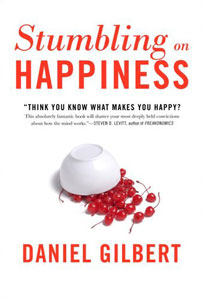
I recently read the book
Stumbling On Happiness, not a book about how to be happy, but about all the psychological reasons we're really very bad at predicting what will make us happy.
Our basic method of predicting our own happiness is to imagine ourselves in a situation, and imagine how happy it would make us. But not only does this technique lead to predictions far off the mark, our
memories of how happy something made us match our predictions far more closely than how happy we really were -- so that we don't even learn from our mistakes.
So, what should we do about it? The book doesn't go into that, with one exception that I will share with you now, but be pre-warned that studies show you are probably too dumb to listen. Think you're not? Let's see...
In a study, a bunch of people, called "reporters", were fed potato chips, and told to write down how happy the snack made them. Several other groups of volunteers were fed different snacks: some were given pretzels, some crackers, some melba toast, etc. Half of these volunteers were told that tomorrow they would be given potato chips and were asked to predict how happy the chips would make them. The next day when they were given potato chips, they found their happiness quite a bit higher than they'd predicted. Perhaps you're not surprised -- potato chips seem less delicious when you're full on snacks than when you're not, and people are very bad at accounting for and adjusting for whatever's going on in the present in how they imagine the future. (It's like the rule: don't go grocery shopping when you're hungry!)
The other half were each given one randomly chosen reporter's description of how happy chips had made her, but
were not told what the snack would be. They didn't know it would be chips. They were asked to predict how happy they unnamed snack tomorrow would make them, based on one random person's report. Their predictions matched their experience much better than the group who knew they'd be eating chips.
What's the moral? Asking someone who's actually in the situation is much more accurate than using your imagination and memory to judge how happy something will make you -- even a randomly chosen person. Sounds simple, but here's the catch:
Some volunteers in the study were told of these results, and were then given a choice: be told what the snack would be, or be given a random reporter's report. Even though they knew the results, they still preferred to decide based on knowing the snack. And you probably will too. Even though you know that asking a random person will be more accurate than being your own judge, you just can't help but think you are more unique than you really are, and that some fellow's opinion tells you little about how
you will react to the same thing. You really
feel that your own judgement, based on memories and imagination, are more reliable than someone else's report, even if the facts show otherwise, and you can't help but tell yourself, "That may be true for other people, but I'm different..." It may be related to why the vast majority of people believe that they are better than average.
Ok, so tell me. Was I right? Are you too dumb to listen to this lesson in happiness?

 While truly insulting stereotypes have become socially unacceptable, a lot of other stereotypes are considered harmless, or even considered true. Are they harmless, or do they have an effect on people deeper than we might think? A study by Shih, Pittinsky, and Ambady is revealing.

